Sony's mid-generation refresh sparked one of the loudest debates in console gaming: is the PS5 Pro actually worth $250 to $300 more than the standard PS5? The short answer is that it depends on your TV and the games you play. The Pro adds a much faster GPU, Sony's PSSR AI upscaler, stronger ray tracing, and double the storage — but none of that matters if you are still on a 1080p display. Here is a full, US-market breakdown of the specs, the real-world differences, and who should (and should not) pay the premium.
Quick verdict
| Buy the standard PS5 if | Buy the PS5 Pro if |
|---|---|
|
|
PS5 vs PS5 Pro price: the $250–$300 gap
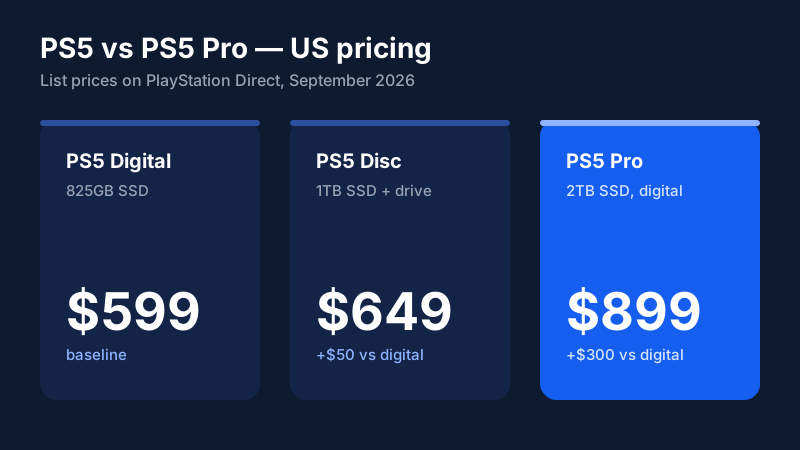
Price is where the debate starts and, for most people, ends. In the US the numbers look like this:
- PS5 Digital Edition (slim): $599
- PS5 (disc version, 1TB): $649
- PS5 Pro (digital-only): $899
That is a $300 gap between the Digital Edition and the Pro, or $250 for the disc-equipped PS5 — and the Pro does not include a disc drive either way. Add Sony's external Disc Drive for $79 and a disc-capable Pro approaches $978 before tax. For that money you could buy the standard PS5 plus two or three full-price games and a spare DualSense controller. Unless you specifically want the Pro's visual headroom, the standard PS5 is clearly the better value.
Specs compared at a glance
| Feature | PlayStation 5 | PlayStation 5 Pro | Winner |
|---|---|---|---|
| Price (US) | $599–$649 | $899 | PS5 |
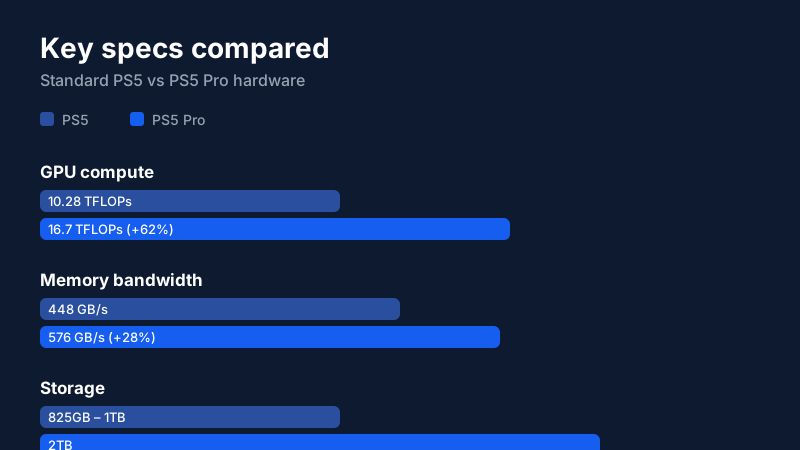
| GPU | 10.28 TFLOPs, RDNA 2 | 16.7 TFLOPs, upgraded RDNA | PS5 Pro |
| CPU | 8-core AMD Zen 2 @ 3.5GHz | 8-core AMD Zen 2 (~10% faster) | PS5 Pro |
| Memory | 16GB GDDR6 | 16GB GDDR6 + 2GB DDR5 | PS5 Pro |
| Memory bandwidth | 448 GB/s | 576 GB/s (+28%) | PS5 Pro |
| Storage | 825GB (original) / 1TB (Slim) | 2TB SSD | PS5 Pro |
| Ray tracing | Standard | Advanced (2–3x faster) | PS5 Pro |
| AI upscaling | None | PSSR | PS5 Pro |
| Networking | Wi-Fi 6 | Wi-Fi 7 | PS5 Pro |
| Disc drive | Built-in (disc model) | None (add-on $79) | PS5 |
GPU and the PSSR upscaler: the real upgrade
The headline change is the GPU, which jumps from 10.28 TFLOPs to 16.7 TFLOPs — a roughly 62% increase in raw compute — plus 28% more memory bandwidth. But raw numbers only tell half the story. The feature that actually moves the needle in real gameplay is PSSR (PlayStation Spectral Super Resolution).
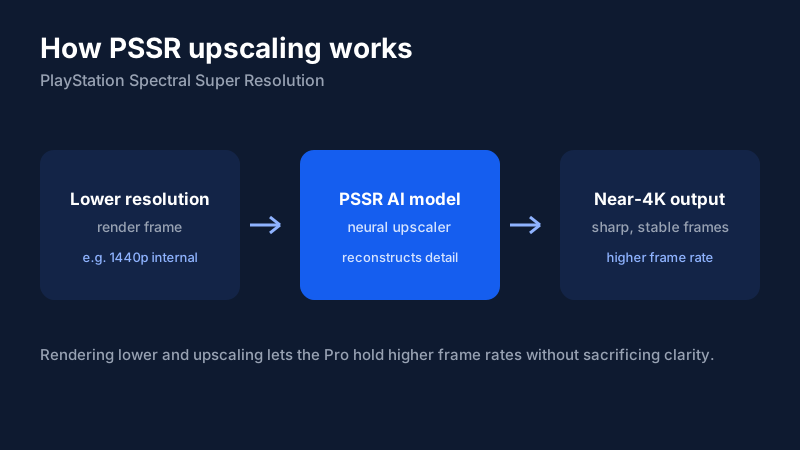
PSSR is Sony's machine-learning upscaler, similar in concept to Nvidia's DLSS and AMD's FSR. Instead of rendering every frame at full native 4K, the Pro renders at a lower internal resolution and then uses a neural network to reconstruct a sharper, near-4K image. The practical result is that supported games can hold higher, more stable frame rates while looking cleaner — grass, text, distant objects, and fast-moving edges all come out noticeably less blurry, especially on a 4K or 120Hz display.
The catch is that PSSR only works its magic in PS5 Pro Enhanced titles that ship a dedicated patch. On a standard 60Hz TV, or in games that never received a Pro update, the visual gain shrinks to almost nothing. That is the core reason this decision hinges on your display and your library.
Ray tracing: a real but selective jump
Both consoles support ray tracing for realistic lighting, reflections, and shadows, but the Pro's upgraded GPU handles it roughly two to three times faster. In Enhanced titles this translates to better reflections and more natural lighting without the frame-rate hit the base console often suffers. Games like Gran Turismo 7 and Spider-Man 2 show off the difference most clearly, but only in their performance modes — and only if your TV can actually display the benefit.
Real-world game performance
On paper the Pro is faster everywhere. In practice, the gains are concentrated in the Enhanced catalogue. Titles such as Final Fantasy VII Rebirth, Marvel's Spider-Man 2, Gran Turismo 7, Alan Wake 2, Hogwarts Legacy, and The Last of Us Part II Remastered all run with sharper image quality, steadier frame rates, or both on the Pro. In action-heavy games the smoother motion is the most obvious benefit; in open-world games, distant detail holds up far better in motion.
Crucially, this is not a universal upgrade. Competitive titles like Fortnite and Call of Duty see improvements, but they are often subtle because those games were already optimised for high frame rates. And a large share of the library — anything without a Pro patch — runs essentially the same on both machines. If your favourite games are not on the Enhanced list, the Pro's extra horsepower is largely wasted.
Storage, Wi-Fi, and the disc-drive catch
Storage is the least glamorous but most practical Pro upgrade. The launch PS5 has 825GB (the Slim bumps that to 1TB), while the Pro ships with a full 2TB. With modern blockbusters routinely crossing 100GB, the extra terabyte means far fewer painful "delete a game to install another" moments. Both consoles still support M.2 SSD expansion, but the Pro simply starts with more room.
On connectivity, the Pro moves from Wi-Fi 6 to Wi-Fi 7, which is faster and lower-latency — a genuine plus for downloads and online play, but only if your router also supports Wi-Fi 7. It is future-proofing rather than an immediate benefit for most people.
The disc drive is where the Pro gives ground. It is sold digital-only, and playing physical games or 4K Blu-rays requires the $79 external drive. If you have a shelf of physical discs or regularly buy used games, the standard PS5's built-in drive is more convenient and cheaper overall.
Design, cooling, and power
The Pro is noticeably bulkier than the Slim PS5, largely because of its larger GPU and a bigger cooling solution. That extra hardware draws more power under load, which is worth knowing if you play for hours at a time — expect slightly higher electricity use. Both consoles are fully compatible with existing DualSense controllers, headsets, charging docks, and PSVR2, so you will not need to rebuy accessories if you upgrade.
A used-PS5 angle worth considering
Before you pay $899 for a Pro, consider the second-hand market. A clean used standard PS5 now sells for roughly $300 to $380, and Sony's own certified refurbished models start around $499. That means you can get into current-gen gaming for less than half the price of a new Pro — and, for most players on a 1080p or 60Hz TV, a used standard PS5 delivers a nearly identical experience. The Pro is only worth its premium if you have a display and a library that can actually show off what it does differently.
Who should upgrade, and who should skip
Upgrade to the PS5 Pro if you own a 4K/120Hz TV or VRR monitor, play PS5 Pro Enhanced games regularly, use PSVR2, or simply want the best-looking console experience available and the $250–$300 price gap does not bother you. Check the latest PS5 Pro price.
Stick with the standard PS5 if you game on a 1080p or 60Hz screen, buy physical discs, play mostly non-enhanced or competitive games, or would rather spend the savings on games and a second controller. For that audience, the standard PS5 — new or used — remains the smarter, better-value choice. Check the latest PS5 price.
Bottom line
The PS5 Pro is a genuinely better machine, but "better" only turns into "worth it" under the right conditions. Its advantages — PSSR upscaling, advanced ray tracing, double storage, and steadier frame rates in Enhanced games — are real and easy to see on a premium display. On an average TV, most of that advantage disappears. If you are chasing maximum fidelity and already own the screen to show it off, the Pro delivers. Everyone else is better off with the standard PS5 and a few extra games in hand.
Frequently asked questions
Is the PS5 Pro worth it in 2026?
It depends on your display and your library. If you own a 4K TV with VRR or 120Hz support and regularly play PS5 Pro Enhanced games, the Pro delivers a clear, visible upgrade. If you mostly play on a 1080p or standard 60Hz TV, you will barely notice the difference and the standard PS5 is the better buy.
How much more expensive is the PS5 Pro?
In the US the PS5 Pro lists at $899, while the standard PS5 Digital Edition is $599. That is a $300 gap before you add the optional $79 disc drive, so a disc-equipped Pro can approach $978 before tax.
Does the PS5 Pro have a disc drive?
No. The PS5 Pro ships as a digital-only console. You need Sony's external Disc Drive ($79) to play physical discs, Blu-rays, or your existing disc library. If you already own discs, factor that cost into the upgrade.
What is PSSR and why does it matter?
PSSR (PlayStation Spectral Super Resolution) is Sony's machine-learning upscaler, similar in spirit to Nvidia DLSS or AMD FSR. The console renders at a lower internal resolution and uses AI to reconstruct a sharper near-4K image, which lets games hold higher frame rates without sacrificing clarity. It is the single biggest reason PS5 Pro Enhanced games look better.
How many PS5 Pro Enhanced games are there?
There are well over 100 PS5 Pro Enhanced titles, including Final Fantasy VII Rebirth, Marvel's Spider-Man 2, Gran Turismo 7, Alan Wake 2, Hogwarts Legacy, and The Last of Us Part II Remastered, with more added every month.
Does the PS5 Pro improve every game?
No. Gains are concentrated in PS5 Pro Enhanced titles that ship a Pro patch. Non-enhanced games may run a bit smoother thanks to the faster GPU, but many look nearly identical on both consoles.
Is the PS5 still worth buying in 2026?
Yes. The standard PS5 still plays the entire PS5 and PS4 library, supports 4K 60fps in most titles, and costs $250 to $300 less. For the majority of players it remains the smarter value.
Should I upgrade from a PS5 to a PS5 Pro?
Only if you already have a premium display (4K/120Hz or VRR) and notice frame-rate dips or softness in the games you play. If your current PS5 already feels smooth, the $250–$300 upgrade is optional rather than essential.
Does the PS5 Pro use more power?
Yes. The Pro's larger GPU and 2TB SSD draw more power under load, which is why Sony fit it with a bigger heatsink and a more aggressive cooling solution. Expect slightly higher electricity use during long sessions.
Is the PS5 Pro better for PSVR2?
Yes. Several VR titles received Pro patches, and the extra GPU headroom helps keep frame rates steadier, which matters a lot for comfort in VR. For dedicated PSVR2 players the Pro is a meaningful step up.